
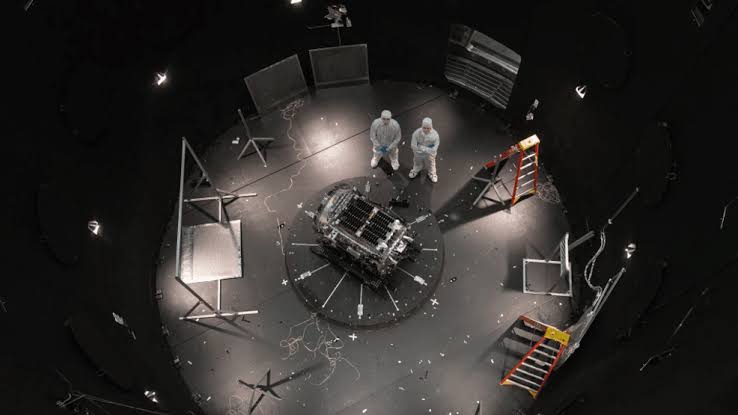
A privately developed spacecraft lifted off on Friday to begin a mission aimed at saving NASA`s aging Swift Observatory, which is gradually losing altitude and could re-enter Earth`s atmosphere without intervention.
The Link spacecraft, built by Katalyst Space Technologies, was launched by Northrop Grumman from the Marshall Islands aboard a Pegasus rocket released from a carrier aircraft during flight.
If all goes according to plan, the spacecraft will rendezvous with the Swift Observatory in about a month before attaching to the telescope and boosting it into a higher orbit, extending its operational life.
NASA awarded Katalyst a $30 million contract for the mission, which is expected to restore the observatory to a safer altitude and allow scientific operations to resume by September.
Swift, launched in 2004, has recently been descending more rapidly because heightened solar activity has increased atmospheric drag on the spacecraft.
The observatory plays a key role in studying high-energy cosmic events, including gamma-ray bursts and supernova explosions. NASA has temporarily suspended its scientific observations to conserve the remaining orbital altitude until the rescue mission is completed.
Currently orbiting about 360 kilometres above Earth, the 1.6-ton telescope is expected to be lifted roughly 240 kilometres higher using the Link spacecraft`s propulsion system.
NASA believes similar orbital servicing missions could eventually be used to extend the lifespan of other satellites, including the Hubble Space Telescope, which is also slowly losing altitude due to increased atmospheric drag.
Katalyst completed development of the rescue mission in just nine months after NASA requested an accelerated schedule. Officials had warned that without a timely orbital boost, Swift could descend beyond recovery and re-enter Earth`s atmosphere as early as October.
The launch had previously been postponed several times because of adverse weather and technical issues.
Katalyst Space Technologies CEO Ghonhee Lee described the operation as a high-risk mission, saying the greatest challenge was launching before the observatory dropped too low to be saved. He said Friday`s successful liftoff marked a crucial milestone toward preserving one of NASA`s long-serving space telescopes.